|

Carla de Moel
Thank you for your interest in the first edition of the M&A Monitor for Southern Europe by Dealsuite. This report consolidates research performed by Dealsuite, the leading tool for M&A transactions. It contains statistics and trends for the Southern European M&A mid-market (enterprises with a revenue between €1 million and €200 million) across Spain, Italy, Greece, and Portugal over the first half of 2025.
The aim of this study is to create periodic insights that improve the Southern European market’s transparency and to serve as a benchmark for M&A professionals. We are convinced that sharing information within our network leads to an improved quality and volume of deals.
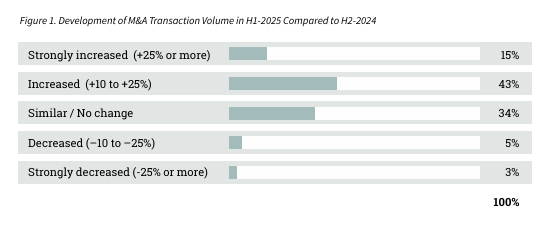
After years of disruption, uncertainty has become a constant in the M&A landscape. Yet in Southern Europe, the market shows signs of structural adaptation. Despite ongoing macroeconomic pressures, 58% of respondents reported an increase in transaction volume in H1-2025 compared to H2-2024, with 15% noting a strong increase of over 25%. Only 8% experienced a decline. This indicates growing resilience across the region, particularly in the SME segment, where dealmakers appear increasingly equipped to navigate volatility as part of the new normal.
In H1-2025, smaller transactions dominated the Southern European M&A market. Deals with an enterprise value below €5 million accounted for nearly half of all activity, with the smallest segment, those under €2.5 million, comprising 26% of the market. Transactions valued between €2.5 and €5 million made up a further 20%. Mid-sized deals were less prevalent, with 15% in the €5–7.5 million range and 17% in the €7.5–10 million bracket. At the upper end, 22% of transactions had a value of €10 million or more.

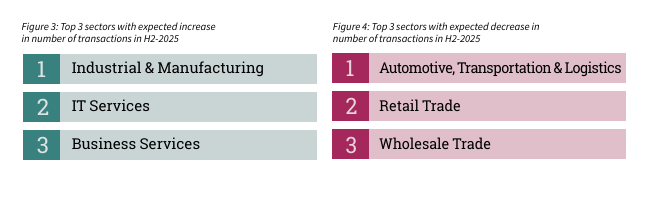
The number of expected transactions in a sector is influenced by a variety of market, industry, and f inancing-related factors. To gain insight into anticipated shifts, advisors were asked in which sector they expect the largest increase or decrease in the number of transactions in H2-2025. Each respondent could indicate one sector. The results are presented in two charts, showing the three sectors most frequently mentioned for an expected increase and decrease.
Industrial & Manufacturing was most frequently cited as the sector expected to see the largest increase (22% of respondents), followed by IT Services (18%) and Business Services (15%).
Automotive, Transportation & Logistics was most frequently cited as the sector expected to see the largest decrease (27% of respondents), followed by Retail Trade (19%) and Wholesale Trade (11%).

The results are explained in more detail in Figure 5 below. These are assignments received in H1-2025 and completed in H1-2025, however, it is worth noting that some of these projects may be completed during a later period or canceled.
In H1-2025, one third of advisors reported a similar number of transactions compared to H2-2024 (34%). While 8% of advisors noticed a drop, 58% reported an increase in the number of assignments.

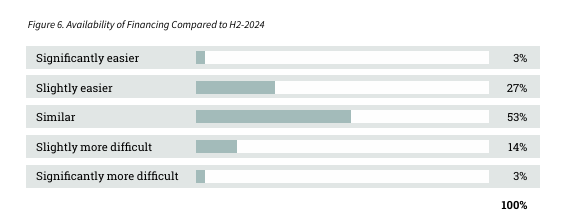
Advisors were asked to report on the availability of financing compared to H2-2024, the results are shown in Figures 6 and 7. According to 53% of the advisors, access to financing in Southern Europe has remained similar compared to the second half of 2024. A total of 30% of respondents report that financing has become easier, whereas 17% indicate it has become more difficult.
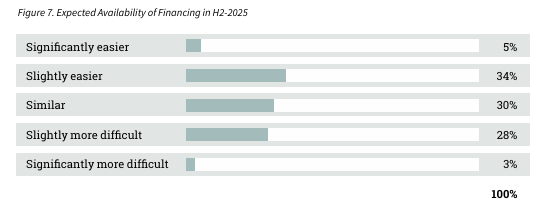
Looking ahead to the second half of 2025, respondents are split in their expectations for financing conditions. While 30% anticipate conditions to remain stable, a notable share foresee some degree of improvement (39%), and a slightly smaller group expect financing to become more challenging (31%).
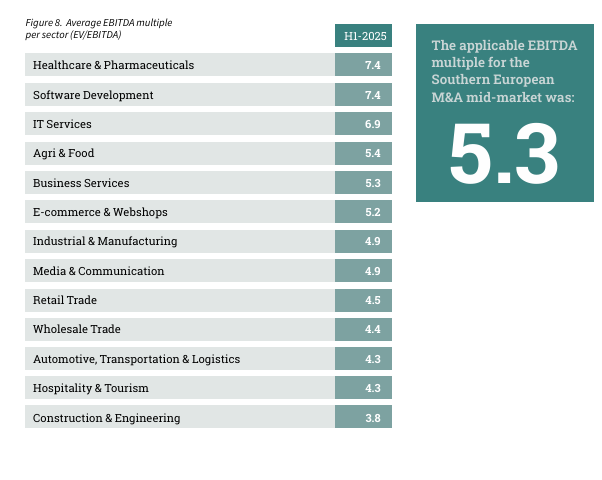
The Average EBITDA Multiple in Southern Europe is 5.3 Defined by collection input from 117 leading Mid-Market M&A advisory firms operating in Spain, Italy, Portugal, and Greece, about transactions completed in H1-2025.
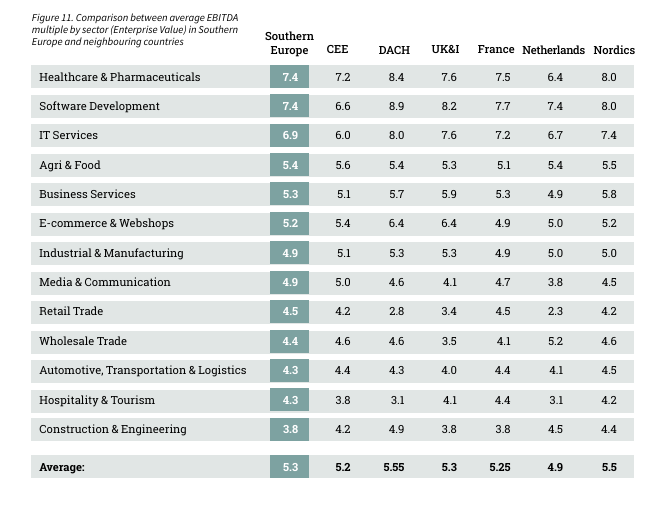
The average EBITDA-multiple in Southern Europe is 5.3 and varies by sector. It ranges from 3.8 (Construction & Engineering) to 7.4 (Healthcare & Pharmaceutics and Software Development). This means that sector averages can differ significantly, ranging from 3.8 to 7.4, almost double depending on the industry.
The results of this study provide a starting point for the applicable sector-multiples. They therefore offer a good benchmark for cross-checking company valuations in the near future.
Company valuations are inherently specific and depend on factors such as growth, profitability, market position, and risk. While a multiple alone is not a complete valuation method, it provides a useful benchmark, particularly for comparing similar transactions in the near term.
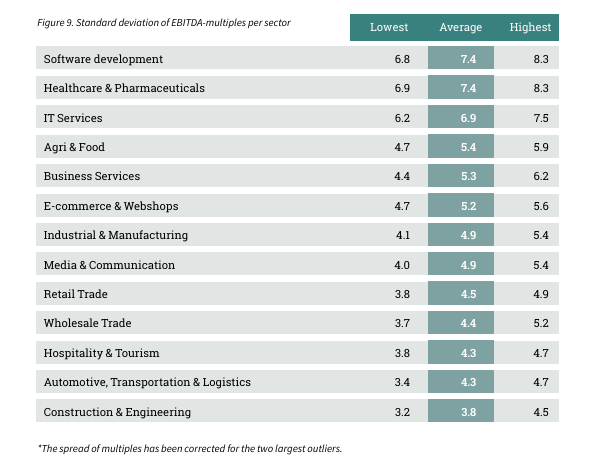
Figure 9 illustrates the distribution of EBITDA multiples by sector. Some sectors encompass a wide range of companies, which explains the broader spreads compared with sectors composed of more similar businesses. The table shows the typical range of EBITDA multiples per sector, though individual transactions can occur at significantly higher or lower levels.
To provide a representative view of a typical company within each sector, the range has been adjusted to exclude the two largest outliers per sector.
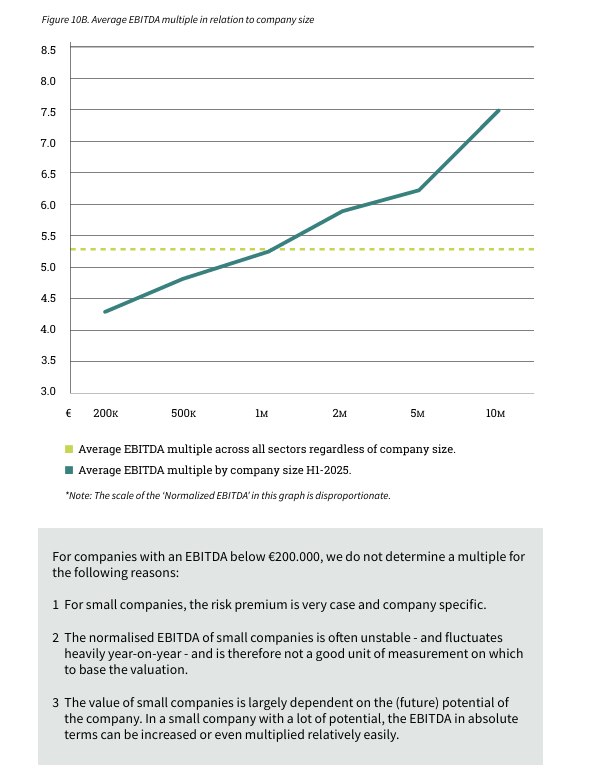
The size of a company can influence the average paid EBITDA multiple. For the first time, the impact of the so-called Small Firm Premium on the average EBITDA multiples for SMEs in Southern Europe is being analyzed. Specifically, companies with an EBITDA ranging from €200,000 to €10,000,000 are considered. This EBITDA range is a realistic representation of SMEs in Southern Europe and is therefore used to express the size of a company.
Research has shown that the smaller a company is, the greater the chance that the expected cash flows will not be realised (Damodaran, 2011; Grabowski and Pratt, 2013). Consider, for example, the dependency on certain customers or suppliers, or the dependency on specific technical know-how that can quickly diminish when staff leave. This can have a significant impact on the returns and thus on the value of a company. The higher risk premium that applies to smaller companies (the so-called Small Firm Premium) causes a value-reducing effect. As a result, the EBITDA multiples paid for larger companies are on average higher than the multiples paid for smaller companies.
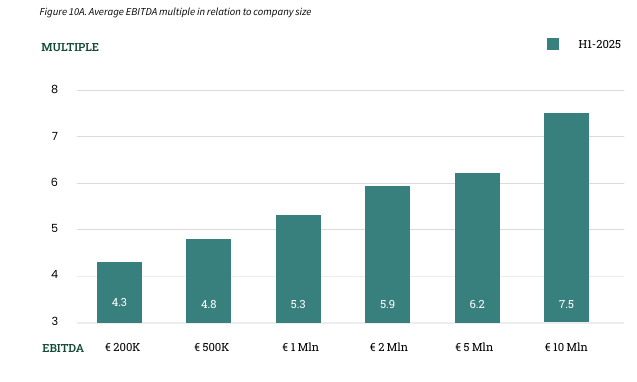
The results of this monitor survey confirm that companies with a low EBITDA have a lower multiple than companies with a high EBITDA. The influence of company size on EBITDA multiples paid is presented in Figures 10A and 10B.
The difference in the EBITDA multiple between companies with a normalised EBITDA of €200,000 and €10,000,000 is 3.2 (4.3 compared to 7.5).
A comparison of EBITDA multiples between different countries highlights the advantages of cross-border deals. For example, it can be beneficial to buy a particular company abroad, or to sell a company to an international buyer. Figure 11 shows the differences in EBITDA multiples between European markets.
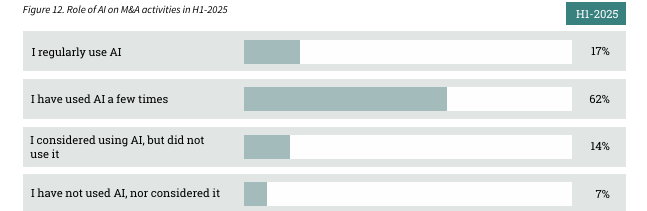
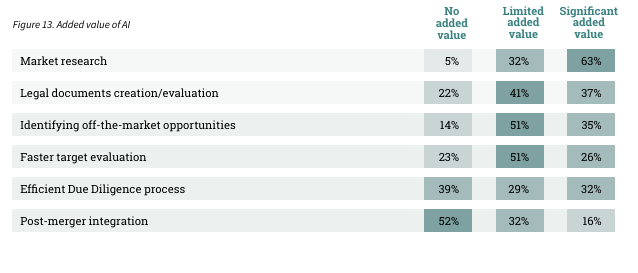
In the first half of 2025, AI has become a widely adopted tool in M&A activities across Southern Europe. 17% report using AI on a regular basis, while the majority of advisors have experimented with it a few times (62%). A smaller group (14%) have considered AI but not yet applied it, and only 7% have not engaged with it at all, underscoring that AI is now firmly embedded in the regional M&A landscape.
In H1-2025, AI is perceived as most valuable in market research, where 63% of respondents reported significant benefits and only 5% saw no added value. Legal document creation/evaluation, identifying off-market opportunities and faster target evaluation are also viewed positively, with a clear majority in each case reporting at least some added value, though fewer rated the impact as significant. In due diligence, opinions are more divided: only about one third of advisors highlighted strong benefits, while many saw limited or no value. Post-merger integration stands out as the least impacted area, with more than half of respondents reporting no added value from AI.
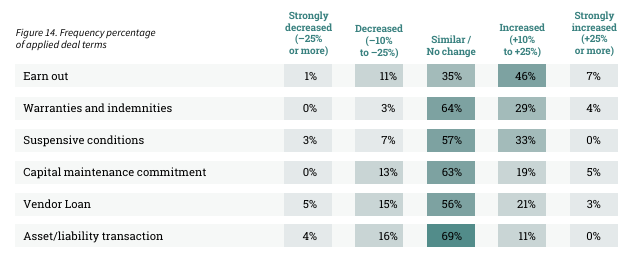
Macroeconomic developments often shape the application of deal terms. In this edition of the M&A Monitor, their frequency and use in Southern Europe were examined (Figure 14).
In H1-2025, earn-outs stood out as the strongest mover, with more than half of respondents (53%) reporting increased application, and only a small minority observing a decline. Warranties and indemnities also gained traction, with one in three respondents noting higher usage. Suspensive conditions showed a similar trend, as 33% reported an increase while most others saw stability.
By contrast, vendor loans and capital maintenance commitments displayed a more balanced picture: a majority reported no change, while around a quarter indicated greater use. Asset/liability transactions, however, appeared the most stable, with nearly 70% noting no change and only limited signs of increase.
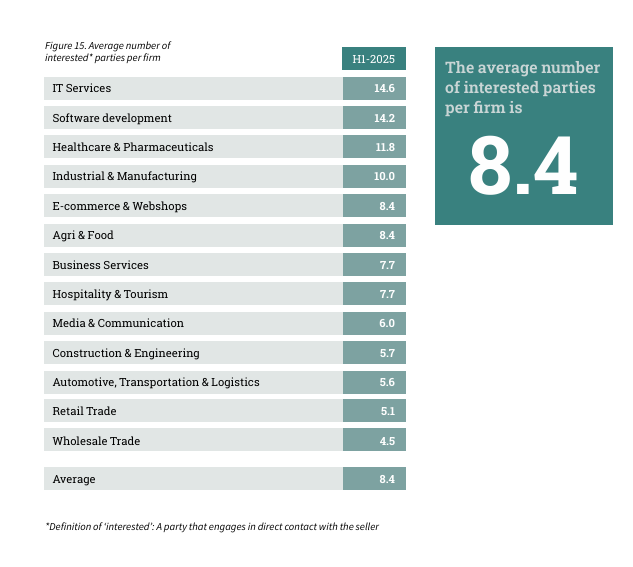
The M&A market is a ‘sellers market’. The balance between supply and demand in the M&A market varies by sector. M&A advisory firms were asked to indicate, for each sector, how many serious potential buyers typically show interest in a company that is put up for sale. The results are presented in Figure 15.
Various factors can influence the number of interested buyers. This is affected, among other things, by financing conditions, economic uncertainty, or sector developments that impact buyer appetite. In H1-2025, the number of average interested parties per offered firm is 8.4.
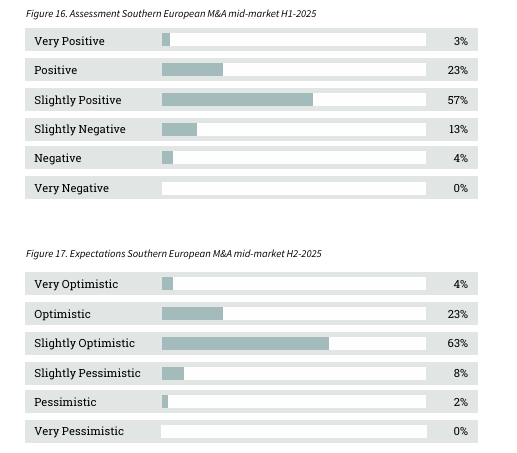
Assessing the performance of the Southern European M&A mid-market is based on many factors, including the willingness of entrepreneurs to sell their businesses, funding availability, macroeconomic developments etc. An interpretation of these factors is needed to determine how the market will develop. The survey included both assessments of the M&A mid-market in H1-2025 (retrospective) and H2-2025 (projection).
Looking back at the first half of 2025, the majority of advisors are satisfied with the performance. 83% of advisors report a positive feeling about the performance of H1-2025, while 17% of respondents held a rather negative view. Looking ahead, 90% of advisors have positive expectations for H2-2025.
The majority of M&A transactions take place in the mid-market. This report uses the definition of a mid market company as having a revenue between €1 and €200 million. The survey was sent to 421 M&A advisory f irms. Considering their combined input, they represent an essential part of the M&A mid-market in Southern Europe. Out of the total of 421 advisory firms, we received 117 responses.
Sources used:
• 117 survey responses from key Southern European M&A advisory firms
• Bain & Company. (2023, March 28). How companies got so good at M&A.
• Damodaran (2011). Equity Risk Premiums (ERP).
• Dealsuite M&A mid-market trends report 2025
• Dealsuite M&A Monitors 2015 - 2025
• Dealsuite transaction data 2015-2025
• Field, A. (2011) Discovering Statistics SPSS. Third edition, SAGE publications, London. 1 -822
This research was conducted by Jelle Stuij, and Roos Bijvoet. For further questions, please contact Jelle Stuij. For further information about Dealsuite, please contact Carla de Moel.


.png)


Grow your network. Find more deals.
Science Park 106
1098 XG Amsterdam
Netherlands
© 2026 Dealsuite. All rights reserved.


.png)
.png)