

Research papers
|

Jelle Stuij
Thank you for taking the time to read this eighth edition of the European M&A Monitor. This report consolidates research conducted by Dealsuite, the leading European platform for M&A transactions. It provides statistics and trends for the European M&A mid-market (enterprises with a revenue between €1 million and €200 million) over the first half of 2026.
A total of 815 M&A advisory firms took part in this research, together responsible for a substantial share of transactions in the European mid-market.
The aim of this study is to create periodic insights that improve transparency and serve as a benchmark for anyone professionally active in the M&A market. While we have been publishing local/regional reports for several years, this is the eighth time we publish this pan-European report, with a focus on inter-regional differences as well as similarities. We are convinced that sharing information within our network leads to an improved quality and volume of deals.

European deal activity edges higher in H1-2026
The European SME M&A market held its footing in H1-2026. Across Europe, 35% of M&A advisors reported an increase in the number of transactions in H1-2026 compared to H2-2025, against 20% who reported a decline. Activity was similar or unchanged for the remaining 45%.
Southern Europe stood out with almost half of advisors (47%) reporting more transactions, the strongest increase of any region. The Netherlands was the only region where advisors more often reported a decline than an increase.

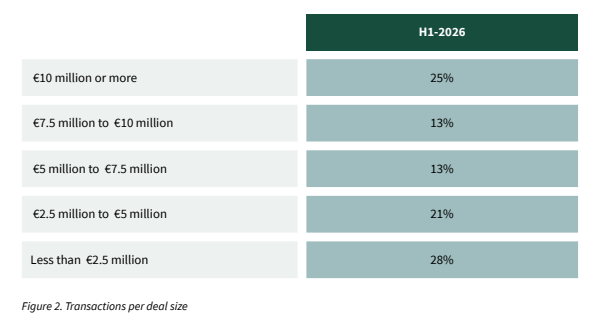
One in four deals now exceeds €10 million
The distribution of deal values shows how transactions of different sizes compare within the mid-market. One in four deals closed in H1-2026 had a deal size over €10 million. Regional appetite for larger deals varies widely: beyond CEE's 35% share of deals above €10 million, Southern Europe (28%) and the Nordics (30%) also lean toward bigger transactions, while the Netherlands (19%) and UK&I see the mid-market's smaller end make up the larger share.
Retail trade braces for a slowdown in every region
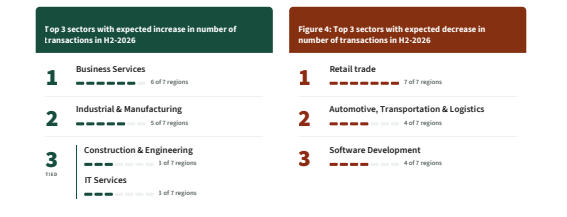
To understand expected developments, M&A advisors were asked in which sector they foresee the largest increase or decrease in deal activity in H2-2026. Each respondent could name one sector.
In six of the seven regions, advisors named Business Services as one of the sectors they expect to see the most growth in during H2-2026; Industrial & Manufacturing was named in five. Retail trade stands out as the only sector advisors in every single region expect to see fewer deals in.
Software Development shows a more divided picture. Four of the seven regions expect fewer transactions there, with several advisors linking this to the impact of AI on valuations and buyer appetite.

Advisory pipelines keep building
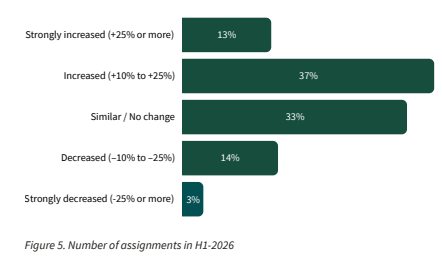
An increase or decrease in assignments received by advisory firms gives insight into expected deal flow and market sentiment. Half of all advisors (50%) reported an increase in new assignments in H1-2026, against 17% who reported a decline. Growth in mandates continues to outpace declines, a positive signal for deal flow in the second half of the year.

Company size continues to drive valuation
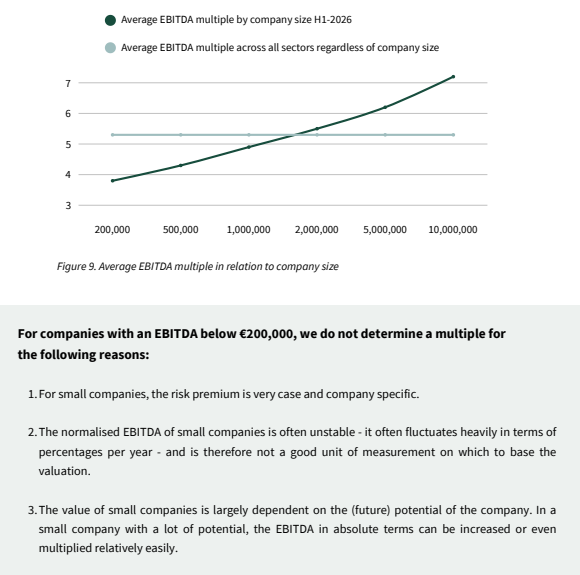
Company size remains a key driver of valuation. For European SMEs, quantifying the Small Firm Premium is particularly relevant for businesses with an EBITDA between €200,000 and €10,000,000. Research shows that smaller companies carry a higher risk of not realising expected free cash flows (Damodaran, 2011; Grabowski & Pratt, 2013). This higher risk profile is corrected for through the so-called Small Firm Premium, which results in a lower valuation.
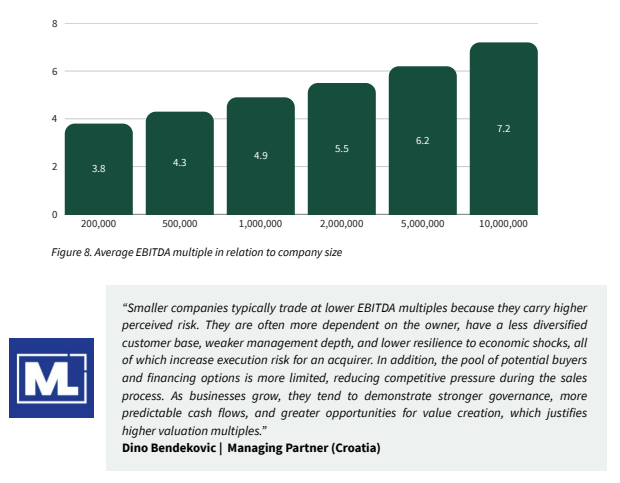
The average European EBITDA multiple, regardless of company size, holds steady at 5.3. Larger companies continue to command a structurally higher multiple: businesses with an EBITDA of €10 million trade at close to double the multiple of those with an EBITDA of €200,000.
Regional valuations converge toward the European average
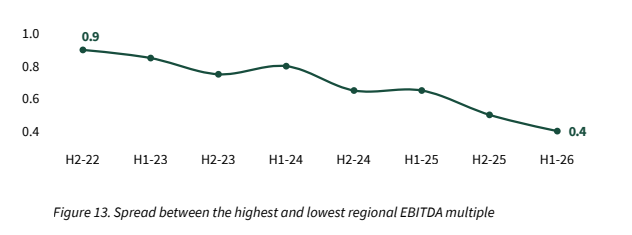
Regional differences in EBITDA multiples continue to narrow. In H1-2026, four regions, DACH, UK&I, the Nordics, and Southern Europe, stand at 5.4, two regions (France, CEE) sit at 5.3, and the Netherlands at 5.0. The spread across all seven regions is just 0.4. This convergence goes hand in hand with growing transparency in market and deal data. Despite this regional convergence, sector-specific valuations still vary considerably by region, forming a strong incentive for cross-border M&A.
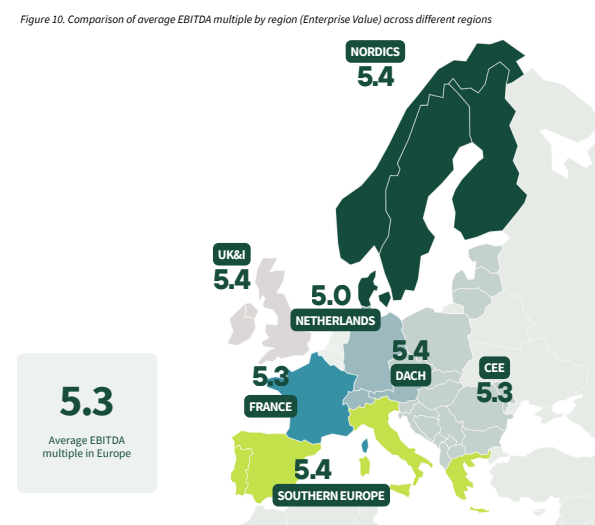
Regional differences in EBITDA multiples
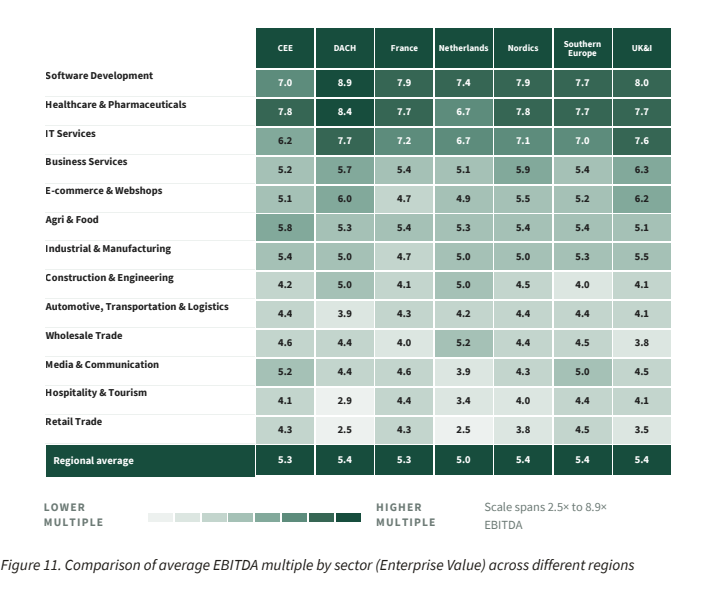
Sector-level differences remain far wider than the regional averages suggest. Retail trade shows the widest spread of any sector, from 2.5 in the Netherlands and DACH to 4.5 in Southern Europe, while Software Development ranges from 7.0 in CEE to 8.9 in DACH.
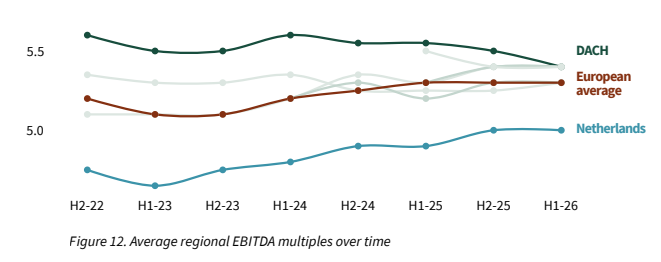
Regional multiples converge after a shared 2023 dip
Since the European Monitor first began comparing regional EBITDA multiples side by side in H2-2022, every region included in that comparison has moved through the same broad cycle: a shared dip through 2023, followed by a steady climb back to current levels. The European average itself fell to a low of 5.1 in 2023 before recovering to 5.3, where it has now held for three consecutive half-years.
The gap between regions has narrowed considerably over that period. DACH commanded the highest multiple in Europe for three years running, peaking at 5.65 in H2-2022, but has since eased to 5.4, converging with the rest of the field. The Netherlands has recorded the lowest regional multiple in every period on record, but has closed much of the gap, rising from 4.75 to 5.0 over the same stretch. CEE, Southern Europe and the Nordics, added to the European Monitor's comparison from H1-2024 and H1-2025 onward, entered close to the European average and have stayed there since.
Seller expectations run high in half of processes
Previous Dealsuite research identified unrealistic seller valuation expectations as the leading cause of terminated deals. This edition of the European M&A Monitor asked advisors directly how often they encounter this gap between seller expectations and realistic market value, how large it typically is, and how often it ultimately breaks a deal.
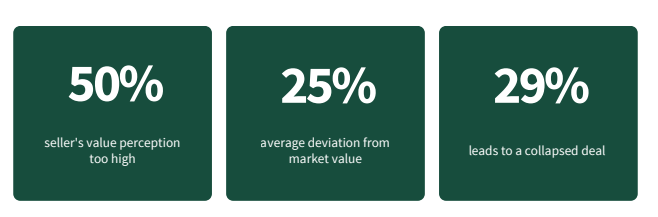
In 50% of transaction processes, advisors report that the seller's value perception is too high. In these cases, the gap to realistic market value averages 25%, and in 29% of these cases, the gap ultimately leads to a collapsed deal.
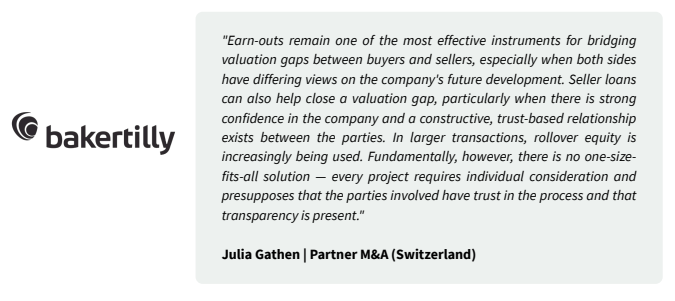
The gap is not evenly spread across Europe. The Nordics reported both the highest share of overvalued sellers (58%) and one of the highest deal-collapse rates (32%), while the Netherlands recorded the fewest process breakdowns of any region, at 19%. Southern Europe saw the highest share of processes derailed by valuation disagreements, at 38%. Advisors most often point to setting realistic expectations early, and to structuring deals through earn-outs and deferred payments, as the way to bridge what remains.
IT Services overtakes software development as Europe's most sought-after sector
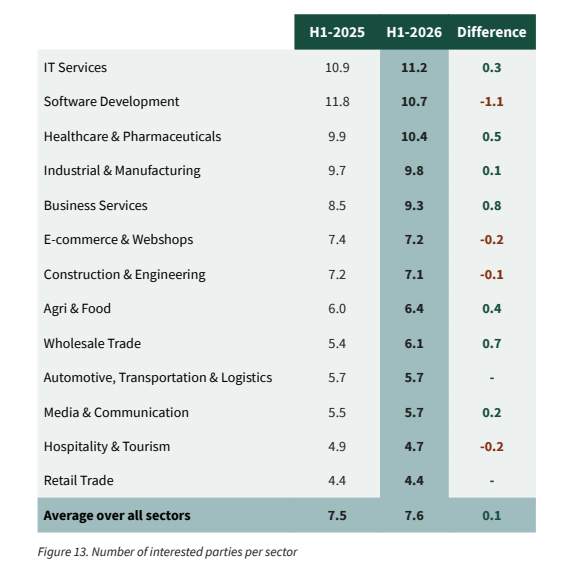
The average number of interested parties per listed company is a useful indicator of buyer appetite and competitive tension in a sale process. IT Services now draws more interested buyers than any other sector, at 11.2 per listed company on average, edging past Software Development (10.7), which topped the ranking a year ago at 11.8. The average number of interested parties per offered company remains stable at 7.6.
Advisors look back on a broadly positive first half
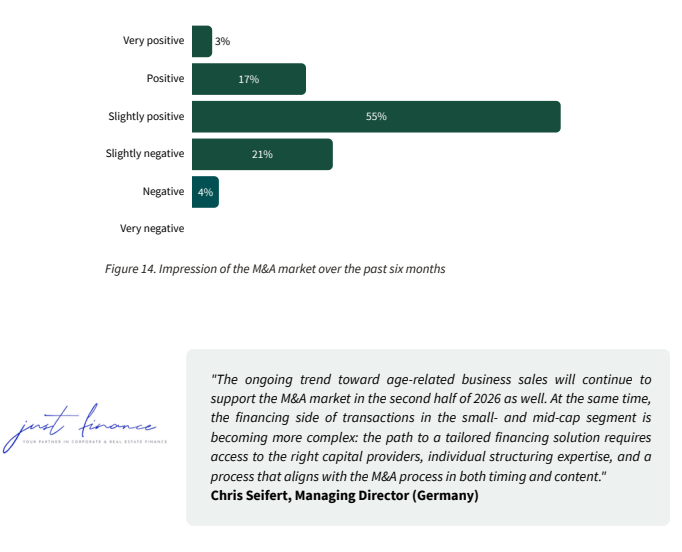
Assessing the performance of the European M&A mid-market is based on many factors, including the willingness of entrepreneurs to sell their businesses, funding availability, and macroeconomic developments. Three in four advisors (75%) rated the M&A mid-market positively over the past six months, with 25% taking a negative view. Southern Europe (85%) and CEE (81%) were the most upbeat regions; France, at 57%, the most reserved.
Sentiment strengthens further heading into H2-2026
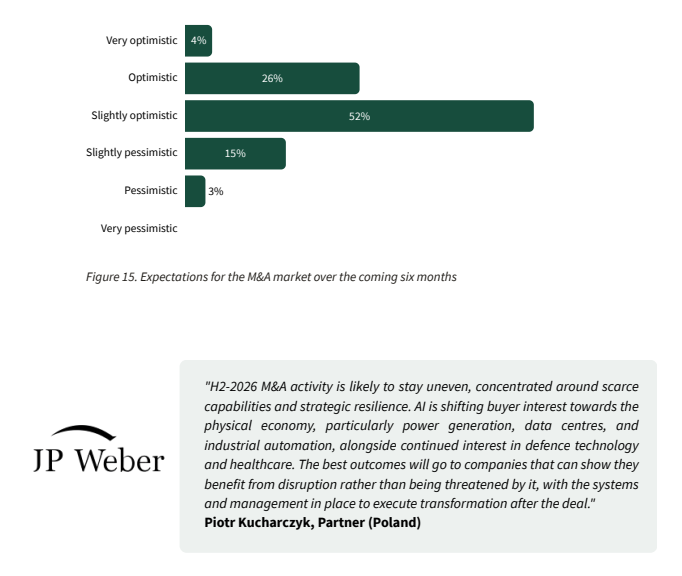
Looking ahead, advisors were asked what they expect from the second half of 2026, taking into account the same underlying drivers, seller appetite, financing conditions, and the wider economic backdrop. Optimism rose in every region except France, where continued political and economic uncertainty ahead of the 2027 elections tempered expectations (63% optimistic, against 79% or higher elsewhere). CEE, Southern Europe and the Nordics were the most confident.
The majority of M&A transactions take place in the mid-market. This M&A Monitor uses the definition of a mid-market company as having a revenue between €1 million and €200 million.
The survey that formed the basis for this M&A Monitor was sent to 2,797 M&A advisory firms active in the European mid-market. Considering their combined input, they represent an essential part of the European M&A mid-market. Out of the total of 2,797 advisory firms, we received 815 responses.
Sources used:
• A total of 815 M&A advisory firms provided detailed input based on the transactions they advised on in H1-2026.
• Dealsuite deal database (2026)
• Dealsuite M&A Monitor research Q1-2015 t/m H2-2025
• Dealsuite. (2026). M&A mid-market trends report 2026.
• Dealsuite. (2025). European Deal Terms Report.
• Bain & Company. (2023, March 28). How companies got so good at M&A.
• Damodaran (2011). Equity Risk Premiums (ERP).
• Grabowski and Pratt (2013). Cost of Capital: Applications and Examples.
• Harding, D., & Rovit, S. (2004). Mastering the merger: Four critical decisions that make or break the deal. Harvard Business Press.
This research was conducted by Jelle Stuij and Roos Bijvoet. For further questions about this research, please contact Jelle Stuij.
For further information about Dealsuite, please contact Maarten Reinders.


.png)


Grow your network. Find more deals.
Science Park 106
1098 XG Amsterdam
Netherlands
© 2026 Dealsuite. All rights reserved.



.png)
.png)