

|

Jelle Stuij
Floyd Plettenberg, CEO, Dealsuite
Thank you for taking the time to read this Sector Monitor on the technology sector in Central and Eastern Europe, a collaboration between Dealsuite and Lexters.
This report combines Dealsuite's own research on M&A activity in the CEE tech sector with legal insights from Lexters and data from external sources. We have published our bi-annual CEE M&A Monitor for several editions now. This is the first time we have applied that regional focus to the tech sector.
Our goal is to improve market transparency in the CEE tech M&A market and provide a valuable benchmark for M&A professionals active in the region. By sharing this information within our network, we aim to elevate the quality and increase the volume of successful deals in the sector.
The Central and Eastern European (CEE) technology sector has become an increasingly active segment within the European M&A landscape, driven by strong structural growth, a fragmented market structure, and rising investor interest. The sector spans software, IT services and digital platforms, as well as telecommunications and data infrastructure. This monitor focuses on software development and IT services.
Software and IT services form a sizeable sector across CEE:
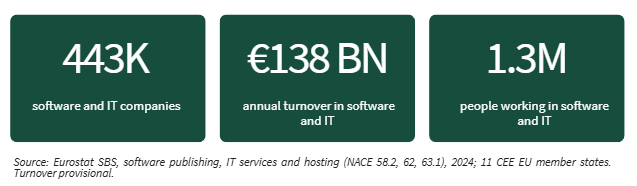
With more than 440,000 companies averaging around three employees each, the sector is highly fragmented. Poland, Romania and Czechia account for almost two-thirds of the workforce. This fragmentation creates a strong foundation for consolidation and sustained deal activity.
Several structural factors underpin both sector growth and M&A activity:
The CEE tech sector has evolved from an emerging market into a scaling ecosystem:
EU-wide rules on data protection, AI and digital markets add compliance obligations, but also give CEE companies a single regulatory standard that Western buyers recognise: an advantage in cross-border deal readiness. CEE remains less mature than Western Europe's M&A and venture markets, though the gap is closing. Western European targets typically arrive with deeper advisory networks and cleaner due diligence processes.
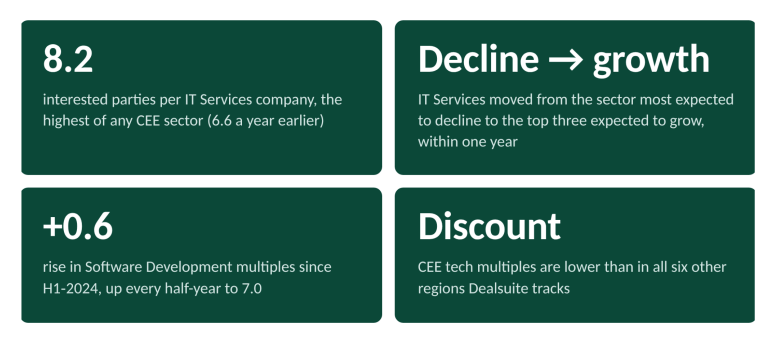
Reliable data on M&A in privately held companies is scarce. The transactions that become public are mostly larger deals, such as those in the CMS figures below, while much of the SME and lower mid-market stays out of view. Dealsuite addresses this from two sides. The Dealsuite Deal Database collects completed transactions logged directly by M&A advisors in our network, building a community-sourced picture of the deals that published statistics miss. The CEE M&A Monitor adds the market view: in each edition, advisors active in the region share their sentiment, the buyer interest they see per sector and the multiples achieved in practice. For tech, both point in the same direction: IT Services now attracts more interested parties per company than any other CEE sector (8.2 in H1-2026), and Software Development multiples have risen every half-year since tracking began, reaching 7.0x in H1-2026.
In 2025, Telecoms & IT recorded 285 M&A transactions in CEE, with a total deal value of €5.24 billion. Across all sectors, CEE M&A reached a record 1,568 deals, up 22.4% on 2024.
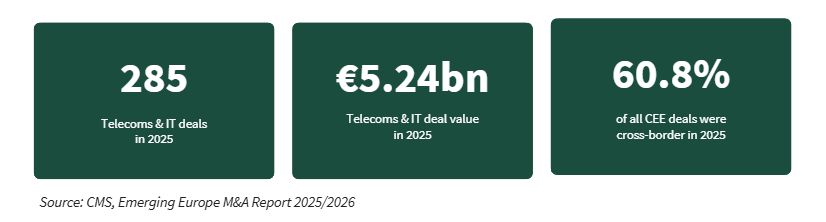
Six in ten CEE deals in 2025 involved a buyer from another country, with the US, UK and Germany the most active foreign investors by volume (CMS, 2026). Alongside this inbound interest, CEE companies are increasingly buying each other.
Why are CEE companies buying across borders?
"Polish companies are looking at Romania and the Baltics, and Romanian companies are starting to look at Poland," according to Lexters.
Strategic buyers and private equity lead the CEE tech market, with venture capital growing behind them. US buyers are drawn by engineering talent at a competitive cost, globally competitive products and valuations that remain attractive compared to Western Europe and the US. Geopolitical and macroeconomic uncertainty has made buyers more selective, not less interested. Momentum is expected to hold in AI, cybersecurity, defence technology, fintech and enterprise software.
Software consolidators are a growing buyer group. Several international consolidators are already active in the region and closing transactions, while others have recently added CEE to their target lists.
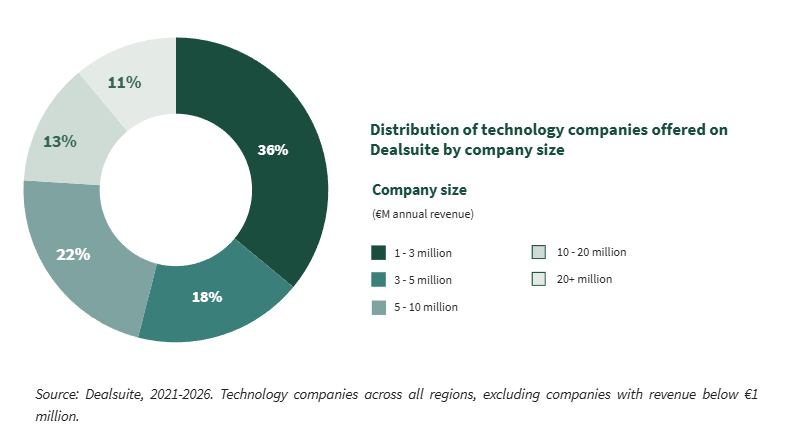
Analysing Dealsuite platform data from 2021 to 2026 reveals that most sell-side deals in the technology sector fall within the €1 to €3 million range, accounting for 36% of the total. Additionally, 11% of sell-side deals exceed €20 million. This ratio is also a good representation of the market, as there are more smaller firms than larger ones.
The average number of interested parties per company brought to market is an indicator of buyer appetite in a sale process. The figure below shows the results for H1-2026 compared to H1-2025.
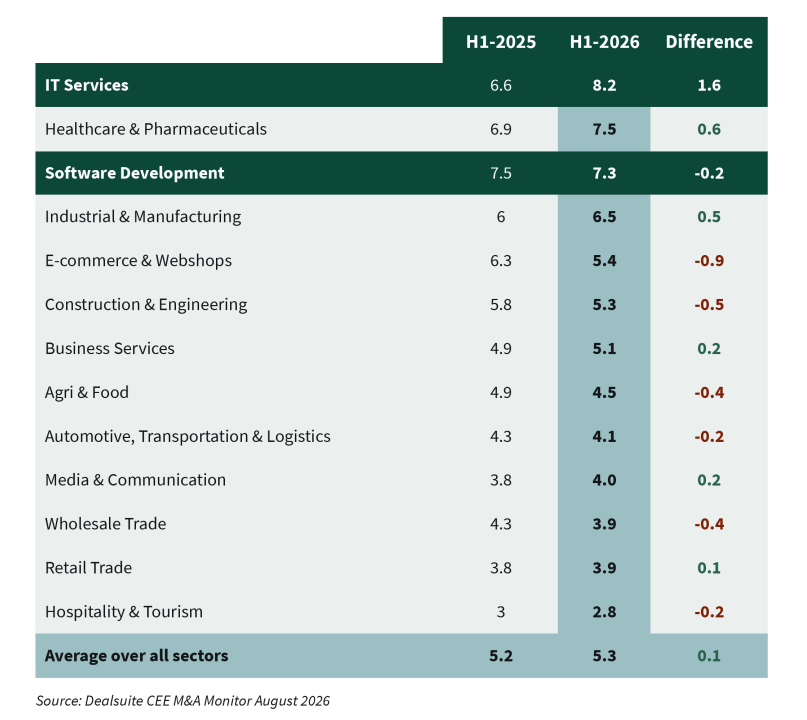
IT Services recorded the largest increase of any sector, from 6.6 to 8.2 interested parties, and now attracts more buyer interest than any other sector. Software Development remained stable, easing from 7.5 to 7.3. The average across all sectors rose slightly, from 5.2 to 5.3.
IT Services has gone from expected decline to expected growth in one year.
The figure below shows the sectors M&A advisors most often expected to see the largest increase and decrease in transactions across the last three editions of the CEE M&A Monitor (August 2025, February 2026 and August 2026). The most significant shift is in IT Services: from the sector most often expected to see a decrease in H2-2025, it has moved into the top three sectors expected to grow in H2-2026.
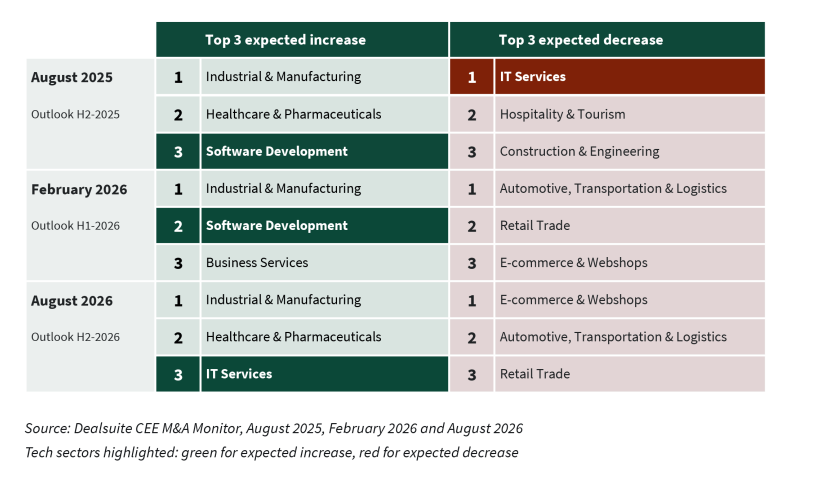
Software Development moved the other way: after ranking in the top three expected to grow in both H2-2025 and H1-2026, it dropped out of that list for H2-2026. This shift in outlook is matched by buyer interest in live processes: IT Services now attracts 8.2 interested parties per company, the highest of any CEE sector, while Software Development eased from 7.5 to 7.3.
Understanding valuation levels in the CEE tech sector is essential for both buyers and sellers preparing for a transaction, and for advisors setting price expectations at the outset of a process. Since Dealsuite began tracking CEE sector multiples (Enterprise Value) in H1-2024, Software Development has risen steadily while IT Services has held flat. Both remain well above the CEE average across all sectors.
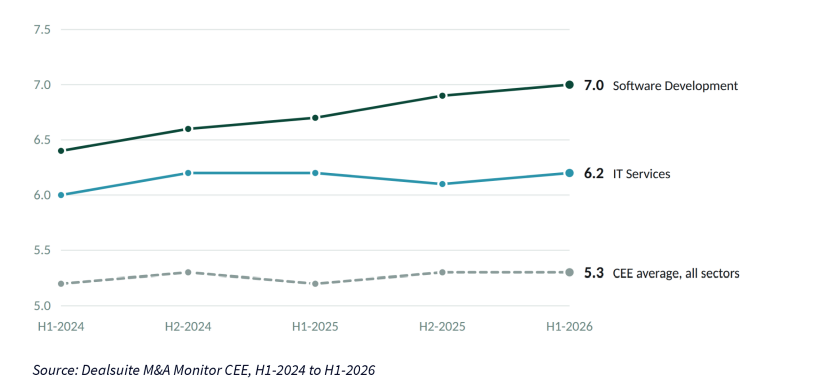
Software Development is the only CEE sector to have risen every half-year since tracking began, +0.6 points in total.
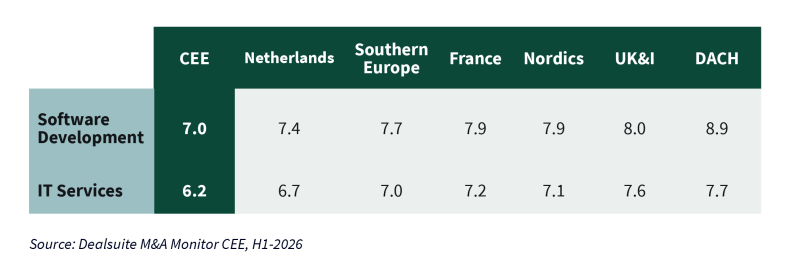
CEE has the lowest tech multiples of all seven regions Dealsuite tracks, in both sectors. The gap to DACH, the highest, is 1.9 points for Software Development and 1.5 for IT Services. For buyers, this makes CEE one of the most attractively priced tech markets in Europe.
Previous Dealsuite research identified unrealistic seller valuation expectations as the leading cause of terminated deals. The latest edition of the CEE M&A Monitor asked advisors directly how often they encounter this gap between seller expectations and realistic market value, how large it typically is, and how often it ultimately breaks a deal.
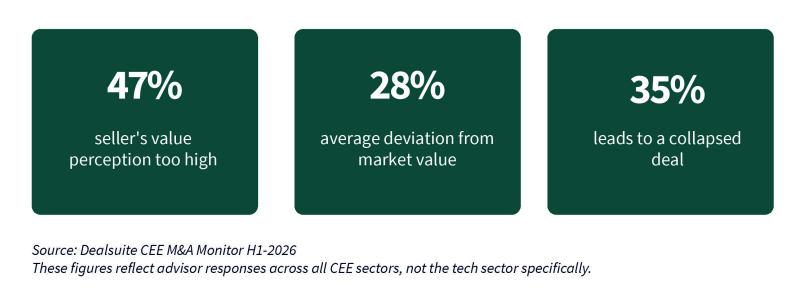
In 47% of transaction processes, advisors report that the seller's value perception is too high. In these cases, the deviation between the seller's expectation and the realistic market value typically amounts to 28%. In 35% of these cases, the valuation gap ultimately leads to the deal being broken off.
Insights provided by Lexters
IP ownership and chain of title. Fast-scaling companies and those relying on freelance developers often have gaps in assignment documentation, so the target may not cleanly own its own source code. In a tech deal this is existential, and calls for IP diligence and remediation before closing.
Representations and warranties. Data protection, open-source usage, key customer contracts and employment arrangements are the usual sticking points. Sellers with lean legal infrastructure resist broad warranty packages, and that is typically where negotiations stall.
Earn-outs and retention. Deferred consideration only works if founders and key engineers stay on. The retention, non-compete and incentive arrangements around the SPA are consistently underestimated.
Regulatory, tax and cross-border rules. Transfer pricing, state aid and sector licensing (fintech, defence technology) add complexity, and rules on share transfers, minority protection, pre-emption rights and notarisation differ by jurisdiction, best mapped early.
An asset deal lets a buyer select specific assets, contracts, IP and business lines while, in principle, leaving unwanted liabilities behind. That flexibility comes with its own conditions.
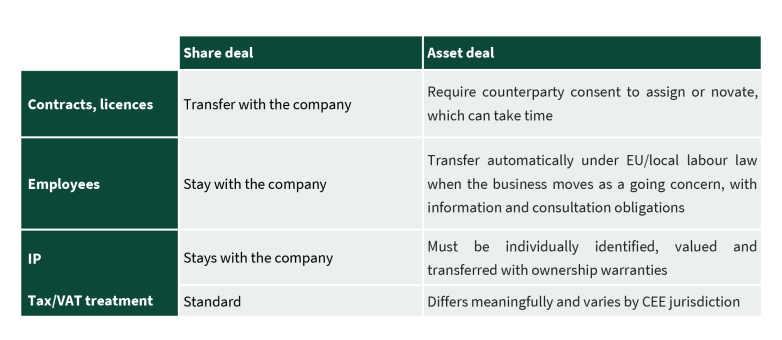
Asset deals come up most often with distressed sellers, carve-outs of a specific business line, or buyers unwilling to take on historical liabilities. They can work well, but need careful planning so the transferred business is operational from day one.
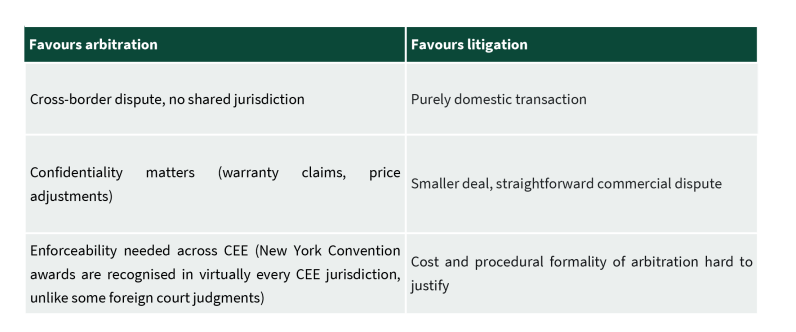
When The Sandbox acquired Timișoara-based QED Builders in 2025, part of the purchase price was paid in tokens. There was no Romanian precedent for token-based M&A consideration. "The entire payment architecture had to be designed from first principles."
At the time of the acquisition, QED Builders was a Timișoara-based company specialising in blockchain and Web3, founded by Ioana Verebi, Vlad Temian and Marius Bălaj. It developed custom avatars and digital assets for The Sandbox, one of the world's leading decentralised metaverse platforms, which lets users create, own and monetise virtual experiences on blockchain.
For The Sandbox, acquiring QED meant bringing a key content-creation function in-house. The deal secured a proven team with deep expertise in avatar design and digital asset creation, and allowed the platform to accelerate product development. For the founders, joining The Sandbox offered a financial return and long-term continuity for the product and team, with access to a global platform and the resources to scale. The process was bilateral, driven by the strategic fit between the two companies.
Lexters was engaged from the early stages, before any binding documentation was signed, and advised through to closing. In parallel, the firm advised on a related cross-border joint venture with Hong Kong and US venture capital funds to establish a national metaverse hub within The Sandbox world.
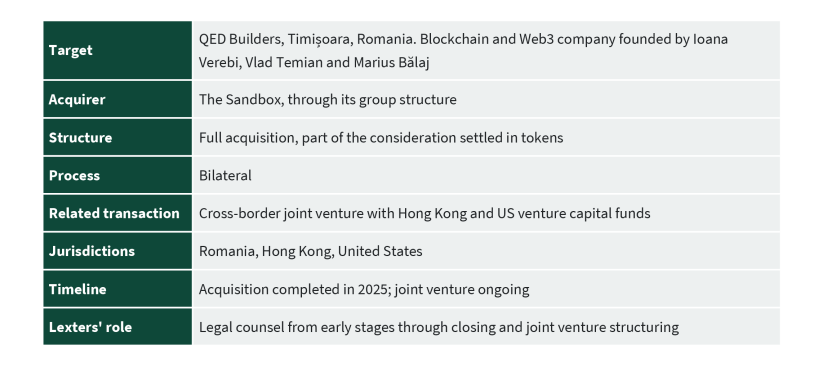
There was no established market precedent in Romania for settling M&A consideration in digital tokens, so the payment structure had to be built as a bespoke contractual framework.
Lexters drafted the full transaction documentation, including the share purchase agreement, ancillary agreements and closing deliverables, together with bespoke token-transfer agreements for the digital asset portion. These covered the legal characterisation of the tokens, a reference valuation, the transfer protocol and settlement window, regulatory compliance, and the consequences of a failed or delayed transfer.
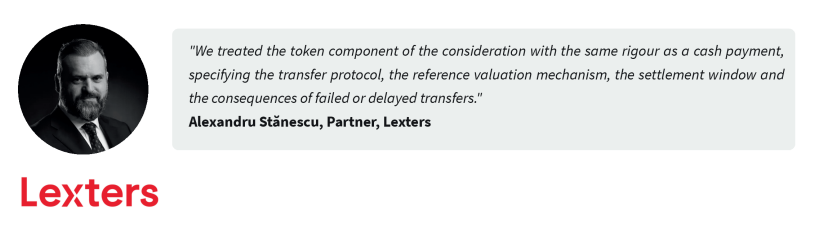
The acquisition required aligning Romanian corporate transfer mechanics with the acquirer's international group structure. The joint venture added a second layer: corporate and regulatory frameworks had to be reconciled across Romania, Hong Kong and the US, and governance, capital contribution and profit-sharing arrangements aligned among venture capital funds operating under different legal systems, on a compressed timeline driven by the pace of the Web3 market.
Lexters prepared a structuring memorandum mapping the governance, capital and exit mechanics across all three jurisdictions, and coordinated with Hong Kong and US counsel so the documentation was enforceable in each.
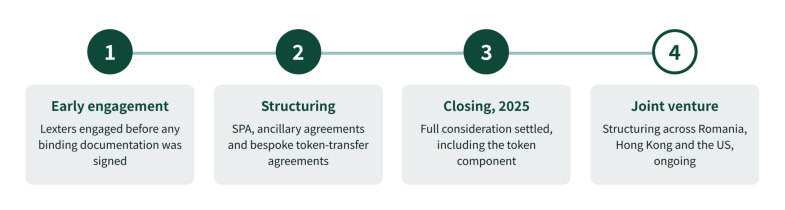
The acquisition closed successfully, with the full consideration, including the token component, settled under the framework Lexters designed. QED's team and technology are now integrated into The Sandbox ecosystem. The joint venture advisory work is ongoing. The figure below summarises Lexters' involvement, from its engagement before any binding documentation was signed through to the joint venture.
In hindsight, Lexters notes that earlier engagement with advisers on the VAT and income tax treatment of the token consideration would have streamlined parts of the closing. The legal framework was robust, but the tax treatment of token transfers remains an evolving area across CEE jurisdictions, and earlier tax structuring could have reduced last-minute adjustments.
The most important lesson for other M&A professionals in the region is that digital-asset M&A requires the same contractual discipline as any traditional acquisition, plus a layer of bespoke drafting. Off-the-shelf SPA templates do not accommodate token transfers, volatility risk or the regulatory uncertainty around digital assets. For these reasons, advisors on Web3 transactions have to build the contractual framework from scratch.
CEE still has room to grow. A less mature ecosystem means less competition for good targets and earlier entry points for buyers. The talent argument is really a competitiveness argument: in Lexters' experience, smaller home markets and less capital push CEE engineers and founders to be versatile and to build for export from day one.
Acquisition interest from Western European and US buyers is expected to keep rising. CEE is no longer only an outsourcing destination: buyers now find properly built companies with scalable products, strong engineering teams and real commercial traction in software, AI, cybersecurity and fintech.
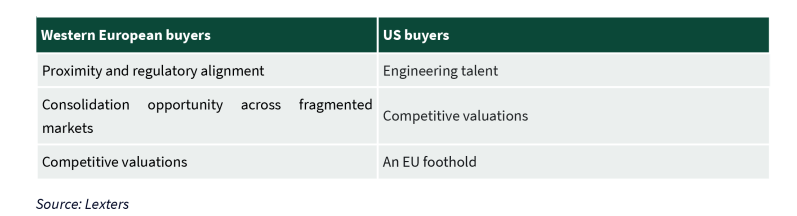
US and German buyers alone account for over 20% of all cross-border CEE deals, with the US the single largest buyer nation (Aventis Advisors, 2025).
Tech companies in CEE increasingly grow across borders, through funding rounds, acquisitions and joint ventures. Each step raises legal questions in more than one jurisdiction, from deal structure to regulation and intellectual property.
Lexters is a Bucharest-based business law firm with a strong focus on the technology sector. Since 2022, the firm has advised startups, founders, investors and established companies at every stage, from incorporation through to cross-border expansion, acquisitions and group consolidations.
Core expertise:
Lexters' partners are admitted to the Bucharest, New York and Paris bars, and the team works in Romanian, English, French, German, Italian and Spanish.
For more information about Lexters, please contact Alexandru Stănescu (alexandru.stanescu@lexters.com), Simina Negulescu (simina.negulescu@lexters.com) or Irina Vasile (irina.vasile@lexters.com).
.png)


Grow your network. Find more deals.
Science Park 106
1098 XG Amsterdam
Netherlands
© 2026 Dealsuite. All rights reserved.


.png)
.png)