Research papers
|

Jelle Stuij
Thank you for taking the time to read this third edition of the Nordic M&A Monitor. This report consolidates research performed by Dealsuite, the leading Nordic and international platform for M&A transactions. It contains statistics and trends for the Nordic M&A mid-market (enterprises with a revenue between € 1 million and € 200 million) over the second half of 2025.
Dealsuite contacted 296 M&A advisory firms operating within the Nordic M&A mid-market.
The aim of this study is to create periodic insights that improve the Nordic market’s transparency and to serve as a benchmark for M&A professionals. We are convinced that sharing information within our network leads to an improved quality and volume of deals.

Increased number of transactions in H2-2025
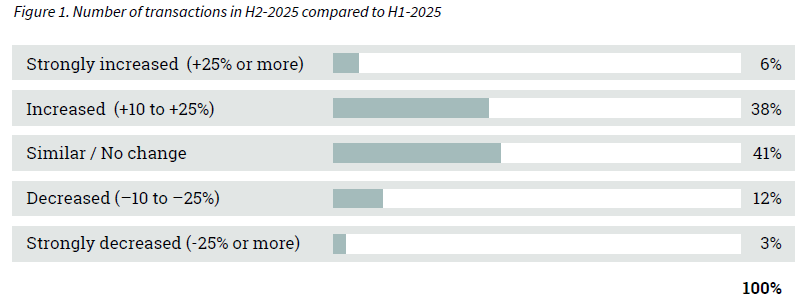
After years of volatility, uncertainty is the new normal in the M&A market. Dealmakers, particularly in the SME segment, are proving resilient and well-adapted to this structural change. To safeguard transaction progress in an unpredictable market environment, dealmakers are increasingly applying flexible deal structures. According to the Dealsuite M&A Deal Terms Report, there is a clear increase in the use of deferred payments and other forms of risk-sharing. In the first half of 2025, transaction volume increased compared to the end of 2024. In the second half of 2025, 44% of advisors again reported an increase in the number of transactions.
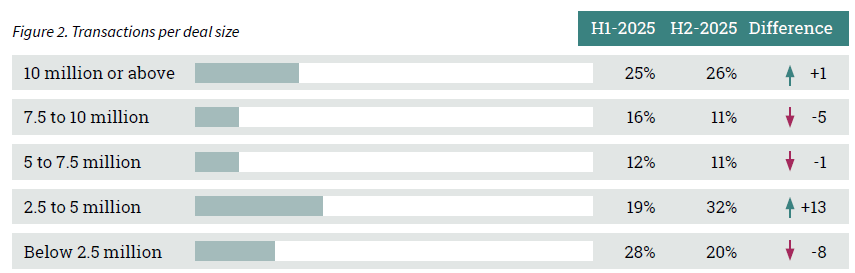
In H2-2025, deal activity in the Nordics shifted toward larger transaction sizes. The €2.5–€5 million segment recorded the strongest growth, increasing by 13 percentage points compared to H1-2025. At the same time, the share of deals below €2.5 million declined markedly. The share of transactions with a deal size above €10 million remained relatively stable at 26%.
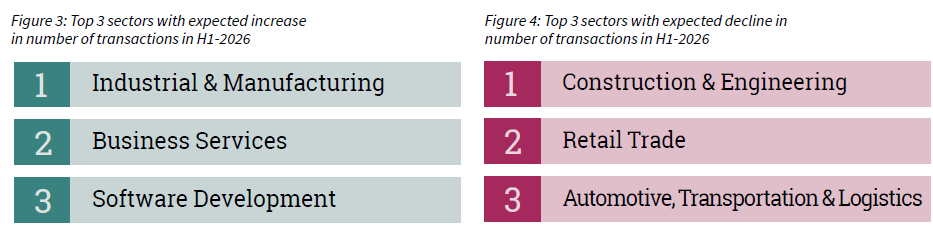
To assess expected market developments, M&A advisors were asked which sectors they anticipate to have the largest increases or decreases in deal activity during the first half of 2026. Each respondent selected one sector. The results are presented in two charts, highlighting the three sectors most frequently cited for expected increases and decreases in transaction volumes.
When asked which sectors are expected to see the largest increase in transaction volume, advisors most frequently mentioned Industrial & Manufacturing, Business Services and Software Development.
When asked which sectors are expected to see the largest decrease in transaction volume, advisors identified Construction & Engineering as the sector likely to see the largest decrease in deal volume in H1-2026, followed by Retail Trade and Automotive, Transportation & Logistics.
Half of advisors report an increase in received assignments
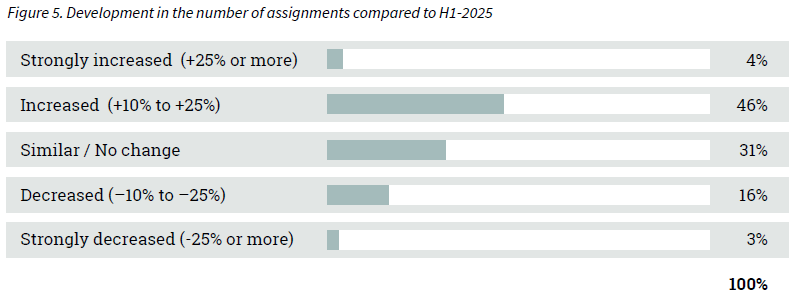
An increase or decrease in assignments at advisory firms provides insight into expected deal flow and market sentiment. The results are shown in Figure 5 below. These are assignments received in the second half of 2025 and (partly) converted into transactions during the same period. In some cases, these assignments will not lead to a deal until H1-2026, or will still be terminated.
In H2-2025, 31% of advisors reported no change in the number of transactions compared to H1-2025. Meanwhile, 19% observed a decline, while half of advisors reported an increase in the number of assignments.
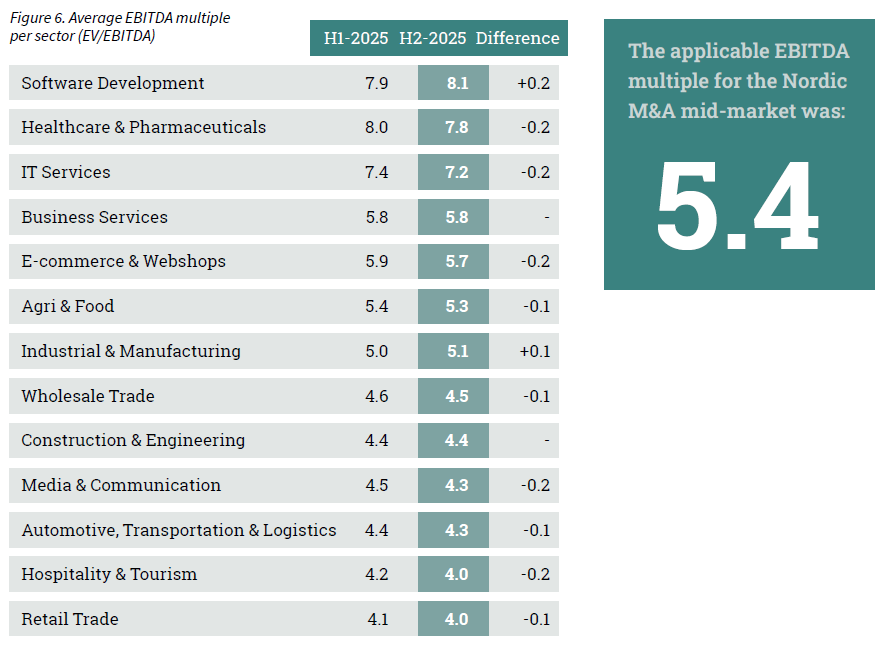
The average EBITDA multiple decreased to 5.4
The average EBITDA-multiple in the Nordics is 5.5 and varies by sector. It ranges from 4.1 (Retail Trade) to 8.0 (Healthcare & Pharmaceuticals), which means that the purchase price differs by up to 95% depending on the sector of the company.
The results of this study provide a starting point for the applicable sector-multiples. They therefore offer a good benchmark for cross-checking company valuations in the near future.
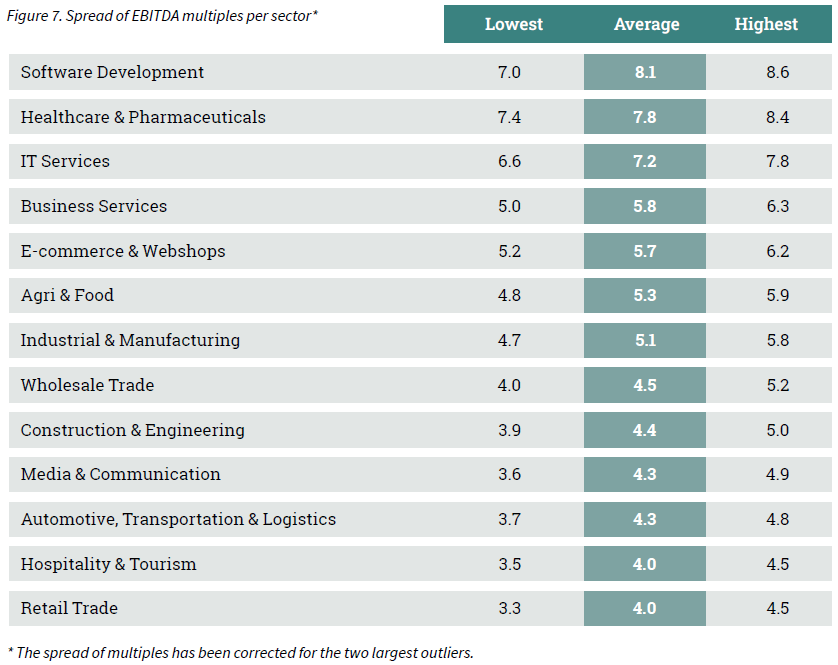
Biggest spread reported in the Business Services sector
A business valuation is inherently company-specific and depends on a wide range of factors, including growth prospects, profitability, market position, and risk profile. A multiple, on its own, does not constitute a complete valuation methodology, but it serves as a useful cross-check, particularly when assessing comparable transactions in the near term.
Figure 7 illustrates the dispersion of EBITDA multiples by sector. A single sector may comprise a broad range of companies with differing characteristics, which explains why some sectors exhibit a wider spread of multiples than others with more homogeneous business profiles. The table presents the typical valuation ranges within which EBITDA multiples generally fall for each sector. In practice, however, transactions may also occur at significantly higher or lower multiples.
To present a representative view of a typical company within each sector, and to show a range that captures where the majority of companies broadly fall, we exclude the two largest outliers per sector.
A difference remains between multiples for large and small companies
The size of a company plays a crucial role in determining multiples in business valuation. For small and medium-sized enterprises (SMEs) in Southern Europe, it is essential to accurately quantify the impact of the Small Firm Premium. This is particularly relevant for businesses with an EBITDA ranging from €200,000 to €10,000,000.
Studies have shown that smaller companies face a higher likelihood of not achieving their expected cash flows (Damodaran, 2011; Grabowski and Pratt, 2013). This can be attributed to factors such as reliance on specific customers or suppliers, or dependence on unique technical expertise that may be lost if key employees leave. Such vulnerabilities can significantly impact a company’s returns and, consequently, its valuation. The elevated risk premium associated with smaller businesses, known as the Small Firm Premium, leads to a reduction in value. As a result, EBITDA multiples for larger companies tend to be higher on average compared to those for smaller companies.
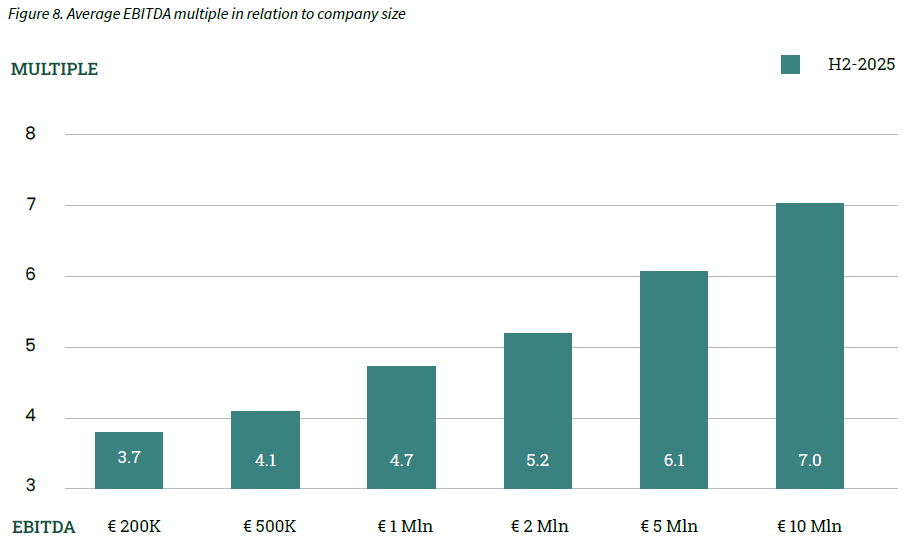
The results of this monitor survey confirm again that companies with a low EBITDA have a lower multiple than companies with a high EBITDA. The influence of company size on EBITDA multiples paid is presented in Figures 8A and 8B.
The difference in the EBITDA multiple between companies with a normalised EBITDA of €200,000 and €10,000,000 is 4.3 (3.7 compared to 7.0).
A comparison of EBITDA multiples between different countries highlights the advantages of cross-border deals. For example, it can be beneficial to buy a particular company abroad or to sell a company to an international buyer. Figure 9 shows the differences in EBITDA multiples between European markets.

75% of transactions are completed within a year
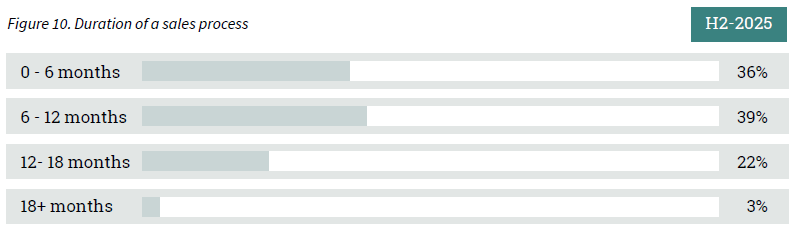
The duration of a sale process is influenced by factors such as market complexity, the seller’s level of preparation, and financing pressure on buyers. The lead time of a transaction, from mandate acquisition to deal closing, can vary significantly.
The lead times of sale processes are distributed on a percentage basis across the categories shown in Figure 10. The majority (75%) of sales processes guided by an M&A advisor had a duration of less than 12 months. 25% of sales processes have a duration of over a year.
Age is the most common reason for selling a business
A company sale can be initiated for a wide range of reasons. In some cases, age plays a role and there is no suitable succession, while in others the objective is to secure the financial value built up over time. In different situations, there may be a need for a new type of management to guide the company into its next phase of growth. In short, the underlying rationale varies by entrepreneur and circumstance.
M&A advisory firms were asked to identify the primary reasons for a company sale. The following reasons collectively total 100% and are presented in Figure 11.
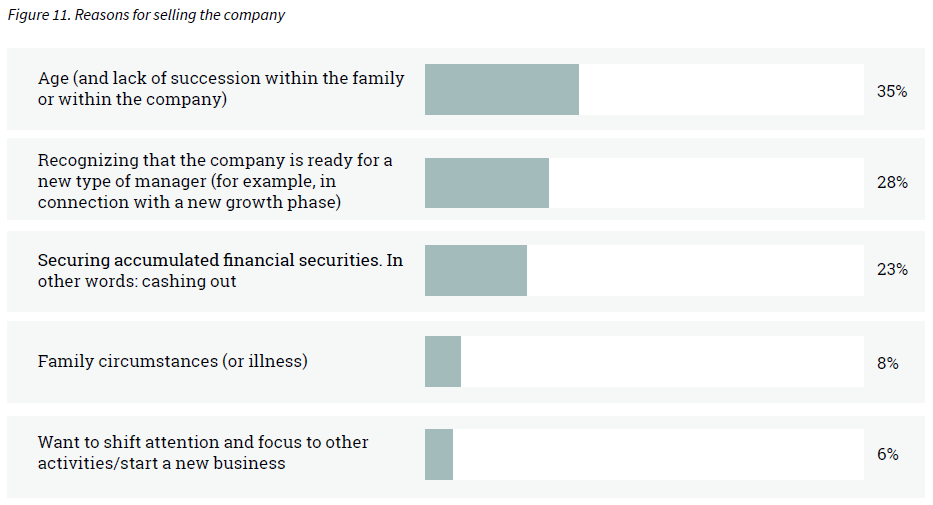
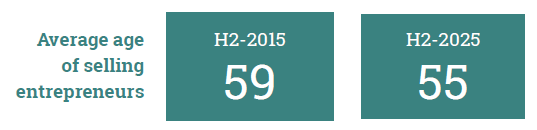
Age (and lack of succession within the family or within the company) remains the main reason for selling a business in 35% of transactions. The advisors were also asked about the average age of a selling entrepreneur, and what the average age was 10 years ago. Over the past ten years (2015-2025), the average age has decreased from 59 to 55.
IX Outlook
Positive assessment of H2-2025 and optimism for H1-2026
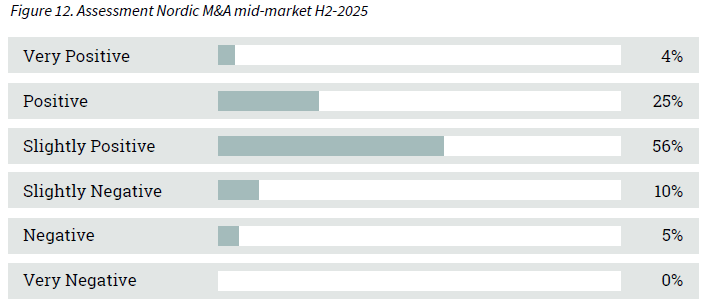
Assessing the performance and outlook of the Nordic M&A mid-market is influenced by a range of factors, including seller willingness, access to financing, valuation expectations, and broader macroeconomic conditions. To capture both current sentiment and forward-looking expectations, M&A advisors were asked to assess the market in H2-2025 (retrospective) and provide their expectations for H1-2026 (projection).
Looking back at H2-2025, the majority of advisors viewed the market positively (85%), while the remaining 15% expressed some level of negative sentiment, most of which was slightly negative.
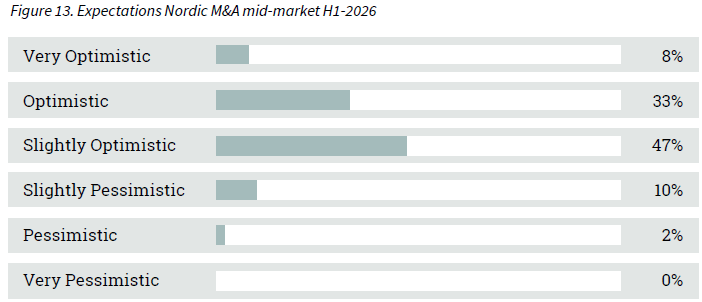
Looking ahead to H1-2026, 88% of advisors express optimism, only 12% hold a more cautious outlook.
The majority of M&A transactions take place in the mid-market. This M&A Monitor uses the definition of a mid-market company as having a revenue between 1 and 50 million euros.
For this edition of the M&A Monitor, Dealsuite conducted a survey among M&A advisory firms active in the mid-market in the Nordics. The survey was sent to 296 advisory firms, which collectively represent a significant share of the regional mid-market M&A landscape. In total, 115 firms provided detailed input.
The conclusions are further supported by Dealsuite’s proprietary data and ongoing market intelligence. Together, these inputs provide a comprehensive view of current market trends, activity levels, valuation developments, and sentiment across the Southern European mid-market M&A landscape.
This study is further supported by other regional Dealsuite M&A Monitors, analyzing the mid-market landscape in the CEE, DACH, UK&I, France, Southern Europe, and the Netherlands.
This research was conducted by Jelle Stuij, and Roos Bijvoet. For further questions about the research, please contact Jelle Stuij. Want to know more about Dealsuite? Please contact Lars Brouwer.


.png)


Grow your network. Find more deals.
Science Park 106
1098 XG Amsterdam
Netherlands
© 2026 Dealsuite. All rights reserved.


.png)
.png)