Research papers
|

Jelle Stuij
Thank you for taking the time to read this twelfth edition of the CEE M&A Monitor. This report consolidates research performed by Dealsuite, the leading UK&I and international platform for M&A transactions. It contains statistics and trends for the CEE M&A mid-market (enterprises with a revenue between £1 million and £200 million) over the first half of 2026.
Dealsuite contacted 461 M&A advisory firms operating within the CEE M&A mid-market.
The aim of this study is to create periodic insights that improve the CEE market’s transparency and to serve as a benchmark for M&A professionals. We are convinced that sharing information within our network leads to an improved quality and volume of deals.

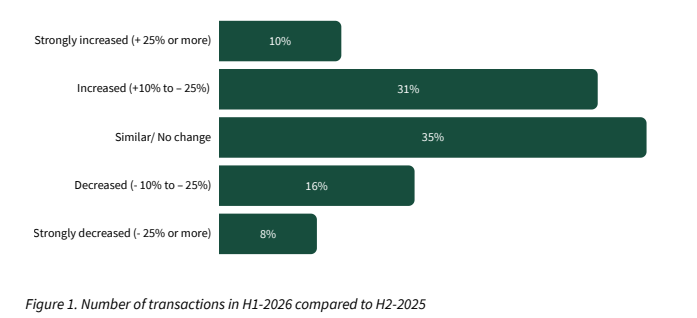
Transaction volume increased in H1-2026
The number of transactions is a key indicator of dynamism in the SME M&A market. Advisors were asked how the number of completed transactions in the first half of 2026 compares to the second half of 2025.
More deals closed with a dealsize above €10m
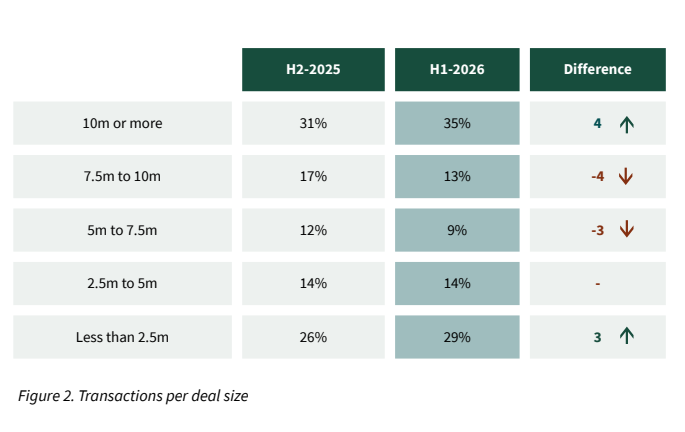
The breakdown by deal value shows how transactions of different sizes are distributed across the mid-market. The share of transactions valued at €10 million or more rose to 35% in H1-2026, up 4 percentage points from H2-2025, the largest gain of any bracket. The share of deals below €2.5 million also increased, up 3 points to 29%, while the €5–7.5 million and €7.5–10 million brackets both eased back, down 3 and 4 points respectively.
Industrial & Manufacturing tops expected growth; E-commerce & Webshops leads expected declines
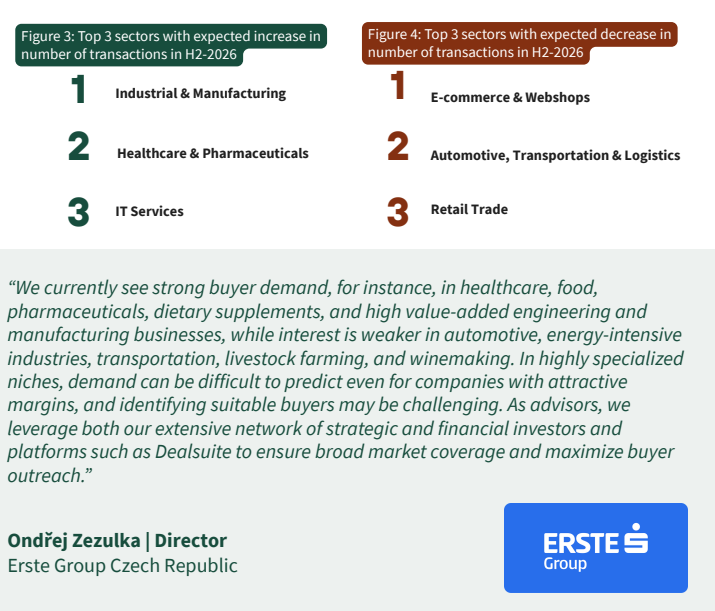
To understand expected developments, M&A advisors were asked in which sector they foresee the largest increase or decrease in deal activity in H2-2026. Industrial & Manufacturing again tops the list of sectors expected to grow, consistent with H2-2025, while Healthcare & Pharmaceuticals and IT Services now round out the top three, displacing Software Development and Business Services. On the decline side, E-commerce & Webshops moves into the top spot, followed by Automotive, Transportation & Logistics, which led the H2-2025 ranking, and Retail Trade.
Assignment volumes continue to build
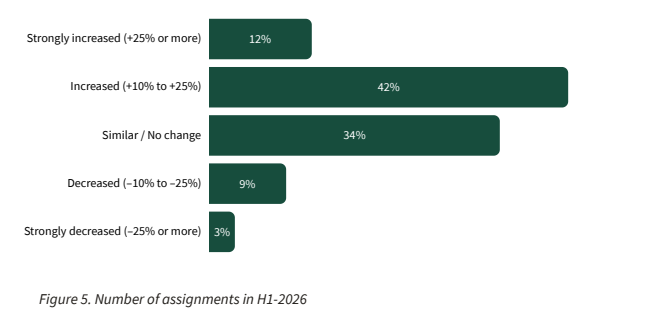
An increase or decrease in assignments received by advisory firms gives insight into expected deal flow and market sentiment. 54% of advisors report an increase in assignments, up from 49% in H2-2025, while 34% report a similar volume and 12% a decrease. Growth in assignments continues to outpace declines, suggesting the pipeline feeding into future transactions remains healthy.
Average EBITDA multiple holds at 5.3
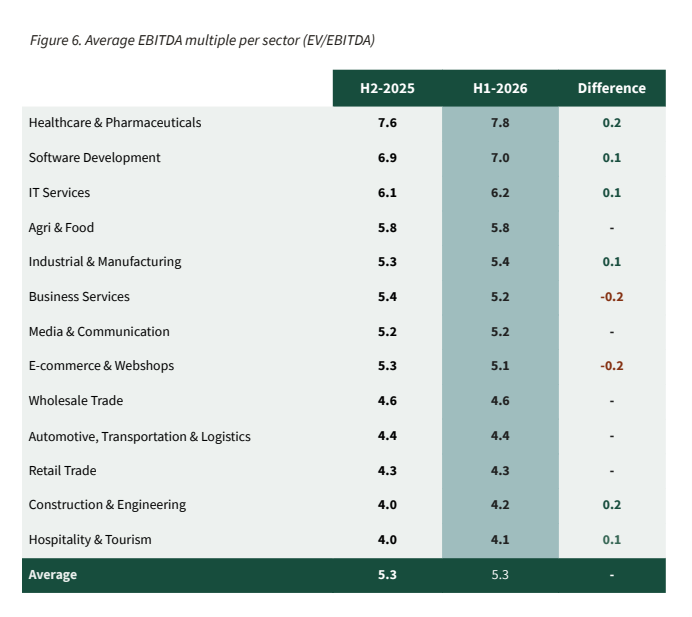
EBITDA multiples are widely used as a benchmark for business valuation, providing an indication of what buyers are willing to pay in specific sectors. The average EBITDA multiple across sectors stands at 5.3, in line with H2-2025. Healthcare & Pharmaceuticals and Construction & Engineering posted the largest gains, both up 0.2.
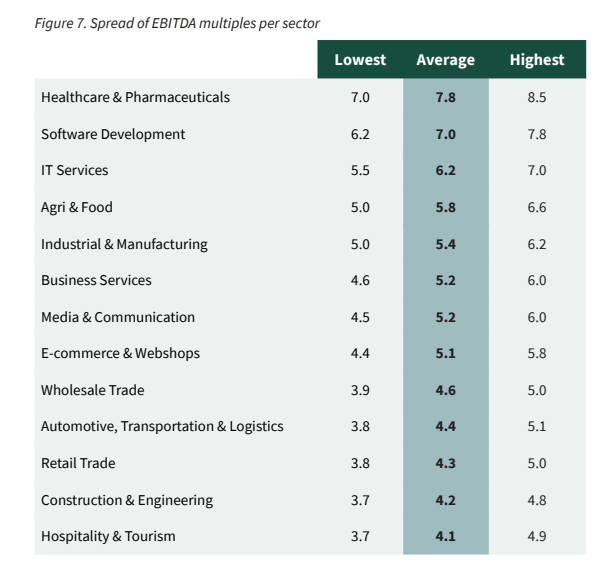
Spread in sector multiples reflects diversity of business models
A business valuation is inherently company-specific and depends on a wide range of factors, including growth prospects, profitability, market position, and risk profile. A multiple, on its own, does not constitute a complete valuation methodology, but it serves as a useful cross-check, particularly when assessing comparable transactions in the near term.
Company size continues to drive valuation
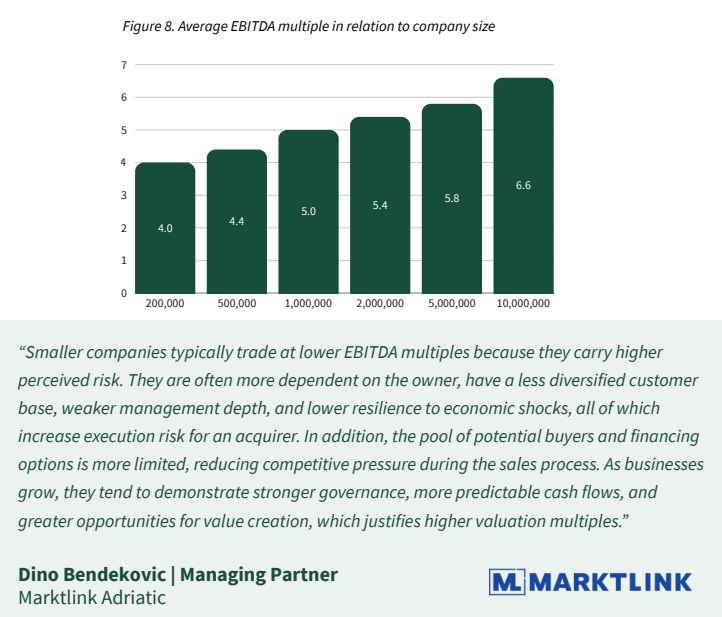
Company size remains a key driver of valuation. For CEE SMEs, quantifying the Small Firm Premium is particularly relevant for businesses with an EBITDA between €200,000 and €10,000,000. The average multiple rises consistently with company size, from 4.0 for companies with €200,000 EBITDA to 6.6 for companies with €10 million EBITDA, a gap of 2.6 points.
Regional valuations converge toward the European average
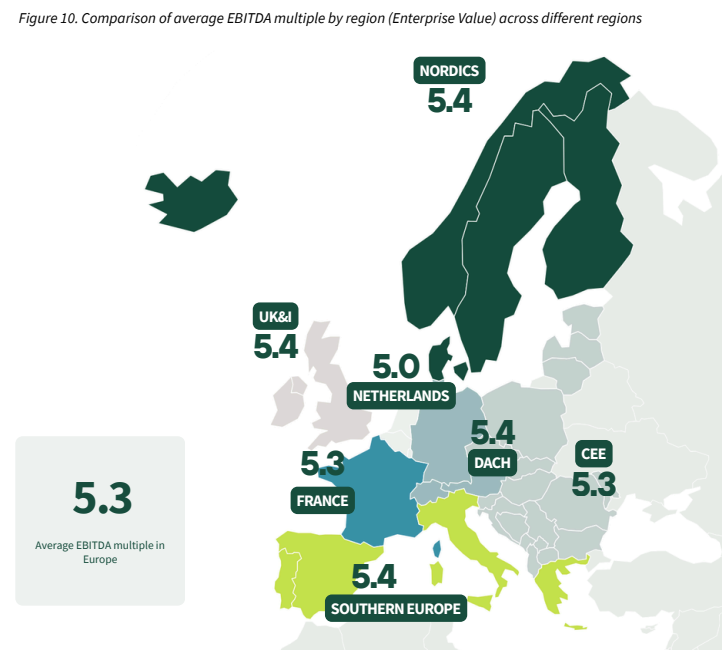
Regional differences in EBITDA multiples continue to narrow. In H1-2026, four regions (DACH, UK&I, the Nordics, and Southern Europe) stand at 5.4, two regions (France, CEE) sit at 5.3, and the Netherlands at 5.0. The spread across all seven regions is just 0.4. Despite this regional convergence, sector-specific valuations still vary considerably by region, which forms a strong incentive for cross-border M&A.
Average EBITDA multiple in Europe: 5.3
Seller expectations run high in nearly half of processes
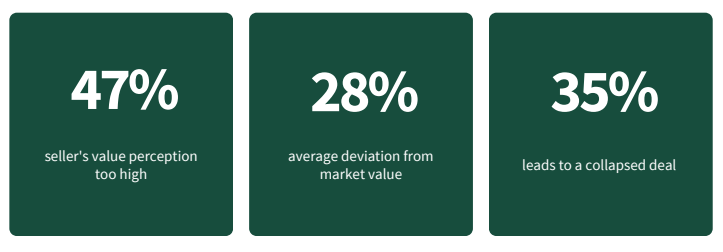
Previous Dealsuite research identified unrealistic seller valuation expectations as the leading cause of terminated deals. This edition of the CEE M&A Monitor asked advisors directly how often they encounter this gap between seller expectations and realistic market value, how large it typically is, and how often it ultimately breaks a deal.
In 47% of transaction processes, advisors report that the seller's value perception is too high. In these cases, the deviation between the seller's expectation and the realistic market value typically amounts to 28%. In 35% of these cases, the valuation gap ultimately leads to the deal being broken off.

Buyer interest remains high
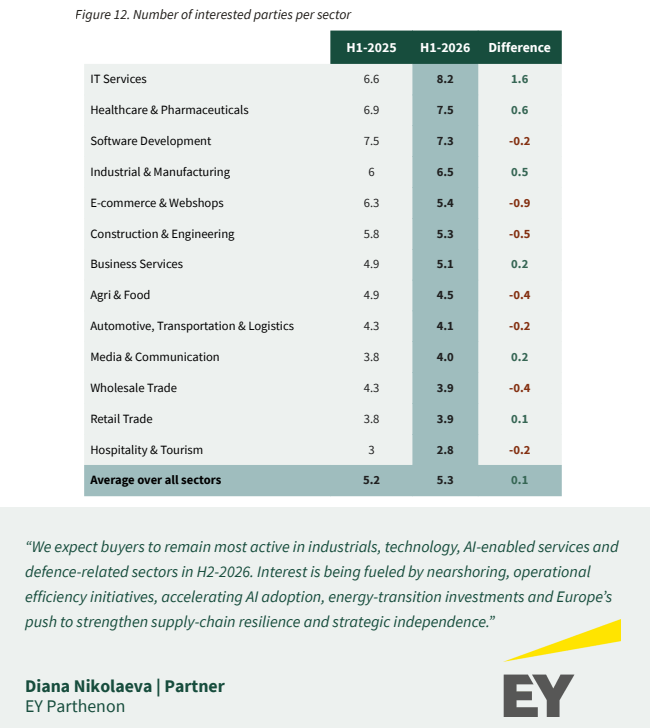
The average number of interested parties per listed company is a useful indicator of buyer appetite and competitive tension in a sale process. Advisors were asked how many serious buyers, on average, expressed interest in the companies they brought to market in H1-2026.
Majority of advisors positive about H1-2026
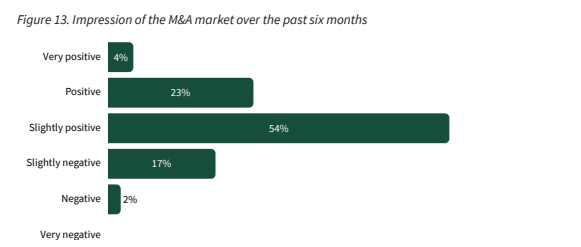
Assessing the performance of the CEE M&A mid-market is based on many factors, including the willingness of entrepreneurs to sell their businesses, funding availability, and macroeconomic developments. A combined 81% of advisors assessed H1-2026 positively or slightly positively, up from 71% in H2-2025, with negative assessments falling to 19%.

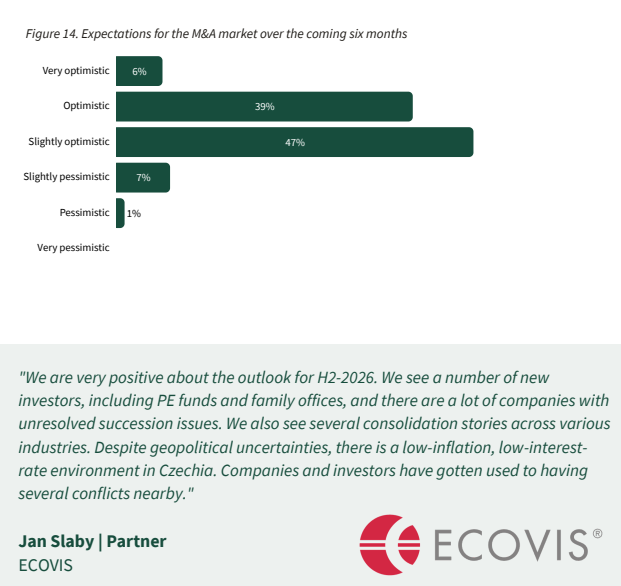
Sentiment strengthens further heading into H2-2026
Looking ahead, advisors were asked what they expect from the second half of 2026, taking into account the same underlying drivers, seller appetite, financing conditions, and the wider economic backdrop. 92% of advisors describe themselves as optimistic about H2-2026, up from the 88% who expressed optimism for H1-2026 in the previous edition's forward-looking assessment. Pessimistic views have narrowed further to 8%.
The majority of M&A transactions take place in the mid-market. This M&A Monitor uses the definition of a mid-market company as having a revenue between €1 million and €50 million.
The survey that formed the basis for this M&A Monitor was sent to 461 M&A advisory firms. Considering their combined input, they represent an essential part of the M&A mid-market in CEE. Out of the total of 461 advisory firms, we received 107 responses (23% response rate).
Sources used:
• A total of 107 M&A advisory firms provided detailed input based on the transactions they advised on in H1-2026.
• Dealsuite deal database (2026)
• Dealsuite M&A Monitor research Q1-2015 t/m H2-2025
• Dealsuite. (2026). M&A mid-market trends report 2026.
• Dealsuite. (2025). European Deal Terms Report.
• Bain & Company. (2023, March 28). How companies got so good at M&A.
• Damodaran (2011). Equity Risk Premiums (ERP).
• Grabowski and Pratt (2013). Cost of Capital: Applications and Examples.
• Harding, D., & Rovit, S. (2004). Mastering the merger: Four critical decisions that make or break the deal. Harvard Business Press.
This research was conducted by Jelle Stuij and Roos Bijvoet. For further questions about this research, please contact Jelle Stuij.
For further information about Dealsuite, please contact Reshem Herm-Singh or Mihai Constantinescu.


.png)


Grow your network. Find more deals.
Science Park 106
1098 XG Amsterdam
Netherlands
© 2026 Dealsuite. All rights reserved.


.png)
.png)